
21 Jul Why Your EV Charger Charges Slow or Trips in Boerne
The car says four more hours. It said four more hours an hour ago. A home charger that crawls or quits mid-session is one of the more frustrating things to own, partly because the problem is almost never the car.
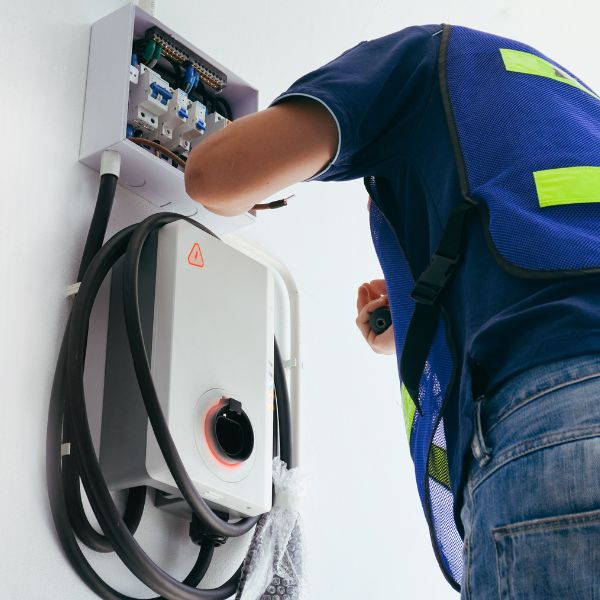
Slow charging and nuisance tripping trace back to the electrical work behind the unit. In Boerne and across the Hill Country, that usually comes down to how the circuit was installed and what else your panel is trying to do at the same time.
Why Your EV Charger in Boerne Charges Slowly
Charging speed is set by the circuit, not the charger’s label. A unit rated for 48 amps only delivers 48 amps if it sits on a circuit built for it, and plenty are not.
The most common culprit is a charger wired to a smaller breaker than it could use. A 40 amp circuit caps charging at 32 amps regardless of what the car or the charger can accept. The hardware is capable and the wiring is holding it back.
Wire size feeds into this too. Undersized conductors on a long run to a detached garage lose voltage along the way, and that lost voltage shows up as slower charging at the car.
Level 1 Versus Level 2
Some slow charging is not a fault at all. A charger plugged into a standard household outlet is Level 1, and Level 1 is slow by design. A standard outlet adds only a few miles of range per hour. For a daily driver that empties most of its battery, overnight is not enough time to recover it.
A dedicated Level 2 charger on a 240 volt circuit is the fix. It charges many times faster and is the setup most households actually need, rather than relying on the cord that shipped with the car.
Why the Breaker Trips Mid-Charge
A charger that trips its breaker is a different problem, and it is one worth taking seriously rather than resetting on repeat.
EV charging is a continuous load. Unlike a microwave that runs for two minutes, a charger pulls steadily for hours, and continuous loads have their own code rules. A circuit that was sized as if charging were occasional will trip under the real, sustained draw.
The safe ceiling is 80 percent of the circuit rating for a continuous load. A charger set to pull the full breaker rating will trip, and the answer is correct sizing, not a bigger breaker on the same wire.
Heat plays a part in a Texas garage. A breaker already near its limit trips more readily when the space around it is running hot, which is why summer brings more of these calls.
The Panel Is the Real Question
Underneath most charging problems is the panel. A Level 2 charger is one of the largest loads a home adds, and it competes with everything else on the service.
Older Hill Country homes were not wired with EV charging in mind. Between central air, a well pump, a pool, and daily living, many panels were close to full before a charger entered the picture.
Add a heavy continuous load to a panel with no headroom and the whole system feels it. Trips spread, lights dim when the car starts charging, and nothing behaves the way it should.
What an Electrician Checks First
Before touching the charger, a good electrician looks at the service. The main breaker rating, the open slots, the busbar capacity, and how much load is already committed.
A load calculation answers the real question, which is whether the panel can carry a charger at full speed without being pushed past what is safe. Guessing at this is how homes end up with the slow, trippy setups people call about later.
When the numbers do not add up, a panel or service upgrade is the honest answer. It is also the moment to size the service for what is coming, not just the charger in front of you.
Planning for More Than One Thing
EV charging rarely stays the only new load. A second vehicle, a shop, or a future solar and battery setup all draw from the same panel.
Sizing a service upgrade with those in mind costs very little at the planning stage and saves a second round of work later. If solar is anywhere in your thinking, it is worth mentioning before the panel work is designed. The homes that end up clean and capable are the ones where someone asked what else was coming before the wire went in.
When to Stop Resetting and Call
Some signs mean it is time for a licensed hand. A breaker that trips repeatedly during charging, a charger or plug that feels hot, scorch marks, or a burning smell near the panel all warrant a stop. Warm equipment and repeated trips are the system telling you the circuit is working harder than it should. Overriding that with resets or a larger breaker trades a slow charge for a real hazard.
A licensed electrician can measure what the circuit is actually doing and tell you whether it needs a repair, a resized circuit, or a panel upgrade behind it.
Getting It Right in Boerne
A charger is only as good as the circuit under it. The unit on the wall gets the attention, but the wire, the breaker, and the panel decide how it performs.
Texas Highlands Electric installs and corrects EV charging for homes across Boerne and the Hill Country, from a single dedicated circuit to the panel work that supports it. The result is a charger that runs at full speed and holds up under daily use.
If your charger is slow, tripping, or not yet installed, contact Texas Highlands Electric to schedule service or request a written quote. It is worth getting right the first time!