
08 Oct San Antonio Electrical Panel Upgrade Timing For 1920s To 1960s Homes
Drive the blocks around Woodlawn Lake or through Beacon Hill and the houses show years of careful upkeep: refinished hardwood, repainted porches, tidy yards. The panel in the hallway closet rarely gets the same attention, and for a lot of houses built between the 1920s and the 1960s, the next San Antonio electrical panel upgrade is the biggest thing standing between the house and the way a household lives now.
These neighborhoods, along with Harlandale and the older streets inside Loop 410 in San Antonio, went up when a house needed lights, a radio, and maybe a window unit. Original service ranged from a small fuse box to a 60 or 100 amp breaker panel, and either one matched that modest demand. Neither was built to run central air, an induction range, and a home office at the same time.
The age shows behind the walls too. Houses from the 1920s and 1930s sometimes still carry cloth-insulated wiring in places, and two-prong outlets are common in rooms nobody has touched since the 1950s. A panel evaluation is a good moment to see what the rest of the system looks like.
How The Load Grew While The Panel Stayed Put
Nobody adds all of it at once. A thermostat here, a camera there, a window unit swapped for a mini split a few summers later. Each change looks small, and that gradual pace is why so few owners notice the panel falling behind. Kitchens tell the story best: an induction range, a double oven, and a refrigerator with an ice maker together draw more than an entire 1950s kitchen did, and all of it traces back to one panel.
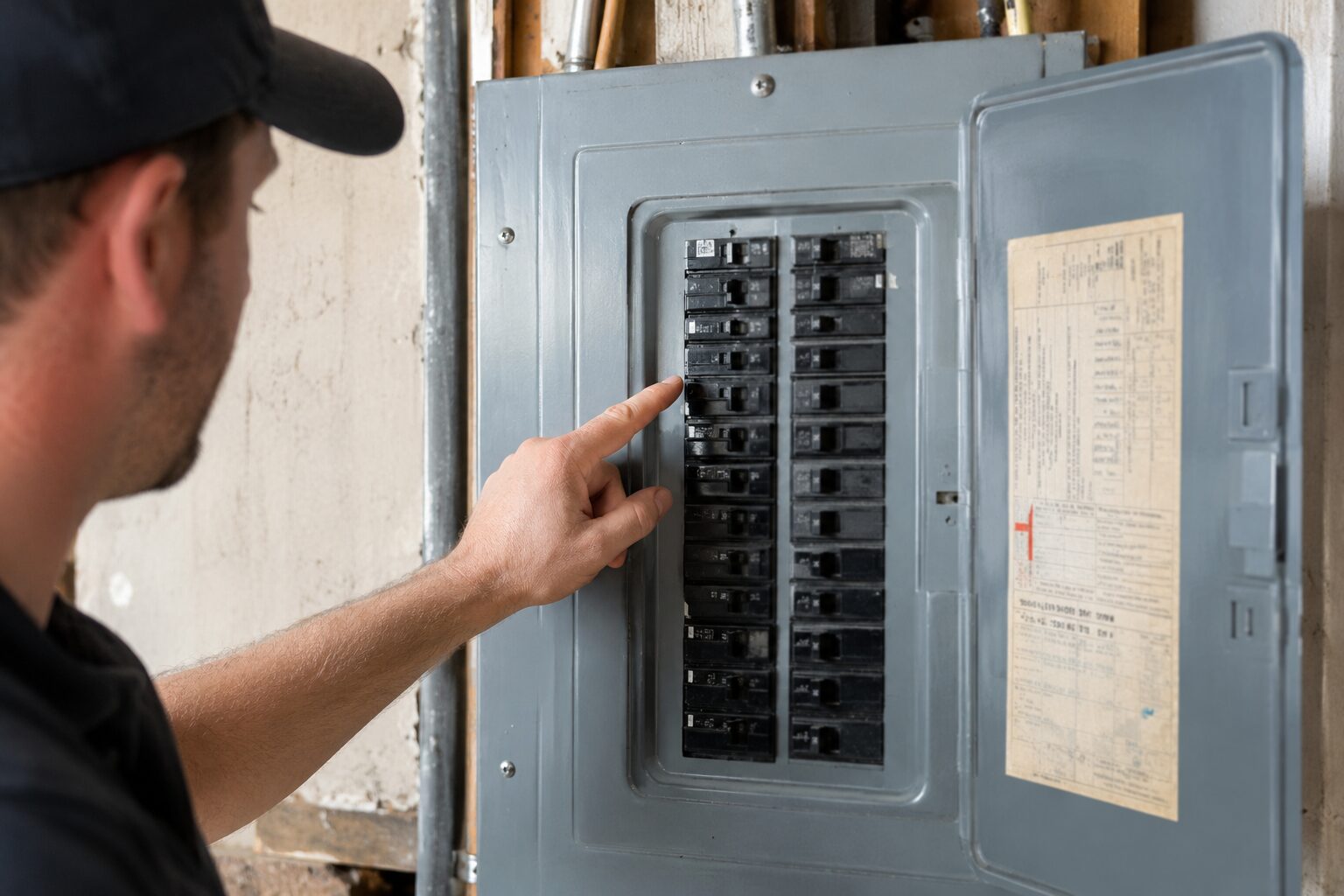
Remodels speed things along. A kitchen update or an added bathroom brings new circuits, and nobody stops to ask whether the panel had room. Houses that changed hands a few times pick up extra circuits the same way, a workshop outlet from one owner and a backyard light from the next, until the panel is working well past what it was rated for. A quick count of the open breaker slots and a look at the labels usually shows how crowded the panel has become.
What Are The Signs Of An Aging Electrical Panel?
A breaker that trips whenever the dryer and the AC run together isn’t a coincidence. Lights that flicker across the house point to the panel and not to one fixture. Warm switch plates, a humming cover, or an electrician telling you there’s no open slot for a new circuit all say the same thing: the panel is out of capacity. Our panel upgrade FAQs cover the common questions.
A burning smell near the panel, even a faint one, is the exception. Everything else can wait for a scheduled visit, but that one deserves a call the same day.
Home inspectors look for the same problems. Three items show up most on inspection reports for older San Antonio houses: double tapped breakers, missing double pole breakers on large appliances, and panels with unlabeled circuits. None is an automatic dealbreaker, but each slows a sale while buyers ask questions, and a panel with room to spare and a clean circuit directory reads very differently from one that’s been patched together over sixty years.
When A San Antonio Electrical Panel Upgrade Makes Sense
An upgraded electrical panel, typically 150 or 200 amps for a house like this, gives you open slots for work you haven’t done yet, like a kitchen remodel or a home office buildout. We size it from a real load calculation covering what the house runs now and what a family reasonably adds over the next decade. Clear labels and spare slots also make the next project easier, since the electrician on your remodel doesn’t have to start by untangling the panel.
Summer is when these houses show strain, with the AC running all afternoon and the dryer, oven, and dishwasher joining in by evening, so a spring or fall upgrade means the power goes off on a mild day. We schedule year-round when a panel can’t wait.
The same aging-panel story plays out in small commercial buildings around town, and just across the city in Alamo Heights we handled a similar bottleneck for a different family in an Alamo Heights panel upgrade.
What Does A Panel Upgrade Day Look Like?
Most upgrades take a single day, with the power off for only part of it. We pull the permit with the city and coordinate with CPS Energy for the disconnect and reconnect, since CPS owns the service up to the meter and everything past it belongs to the homeowner. We test every circuit before we leave, and the inspection follows the city’s schedule.
Grounding comes up on most of these jobs. Older houses often have two-prong outlets or grounding that predates current requirements, and a new panel is the natural time to bring the grounding and bonding up to date and add GFCI or AFCI protection where the code calls for it on the circuits we touch.
If your house was built before 1965 and nobody has evaluated the panel, contact Texas Highlands Electric and we’ll look at what you have and whether it still fits how you live.